
AI6 min read
Build vs. Buy Isn't a Hard Decision. It's a Symptom.
When the choice feels impossible, the problem is almost never the vendors. It's the requirements you never wrote down.
View entry→October 15, 2026

An idea is still an idea, even with good formatting. The question isn't whether your spec is detailed, it's whether it's decided.
Joe Guster
October 5, 2026 · 6 min read
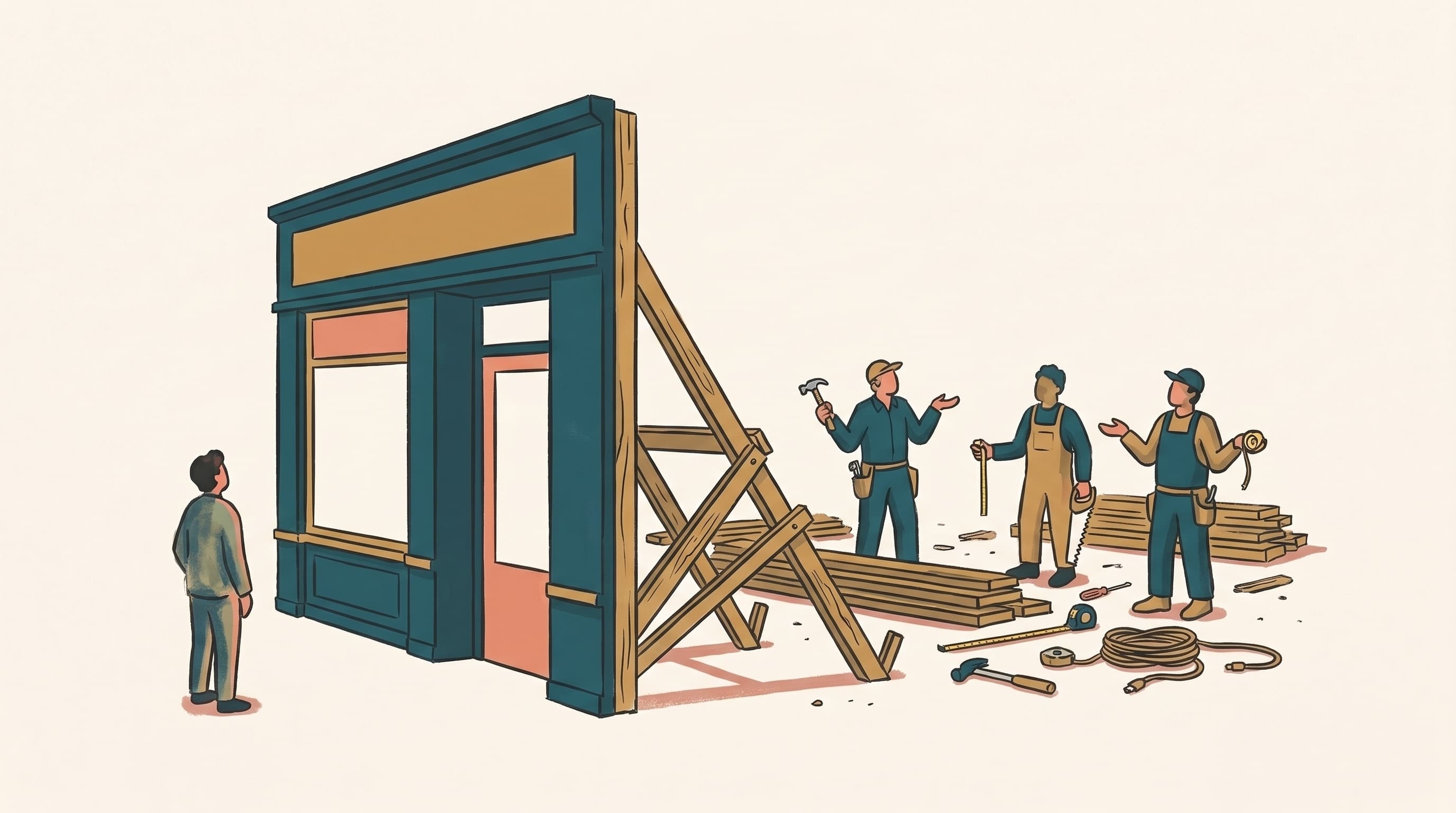
A founder I talked with recently spent a weekend with an AI tool and came out the other side with a 20-page product requirements document. It had personas. It had user stories. It had a feature list organized by priority, a section on success metrics, and a handful of generated mockups that honestly looked pretty good.
He was proud of it, and he had reason to be. A few years ago, getting a document like that would have taken weeks and probably a consultant. He felt like the hardest part was done. All that was left was handing it to a development team and letting them build.
Then the team's first round of questions came back. Not one of them was answered anywhere in those 20 pages.
I wrote in my last post that speed doesn't fix a fuzzy spec, it multiplies it. That post was about what happens during the build. This one is about the moment before it: the handoff, and the gap between how a spec feels to write and how it feels to build from.
AI is genuinely good at a certain kind of product writing. It can describe who your users are, what features they need, and what the ideal path through your product looks like. It can do this fluently and quickly, and the output reads like something a professional produced.
But that's not what developers get stuck on. Here's what a typical AI-assisted PRD says, and what the team building it still has to figure out:
"Users can book appointments with providers." Whose calendar is the source of truth? What happens when two people book the same slot at the same moment? Can a booking be edited, or only cancelled and rebooked?
"The app integrates with Stripe for payments." When is the card charged, at booking or after the service? What happens if the charge fails? Who handles refunds, and does that require an admin screen?
"Admins can view reports on user activity." Which activity? Stored how, and for how long? Real-time, or is a daily summary fine? Does "admin" mean one role or several?
"The platform supports multiple locations." Does each location have its own data, or is it shared? Can a user belong to more than one? Is billing per location or per account?
Every one of those questions has a real answer, and the answer changes what gets built. Some of them change the database design. Some change how long the project takes by weeks. None of them are hard to ask. They're just not the kind of thing that shows up when you describe a product from the outside.
That's the pattern. AI-generated specs describe the product. Builders need the product decided.
Here's the part I think most founders miss.
When a spec leaves a question open, the question doesn't stay open. The build can't pause forever. At some point, someone makes a call, and if the spec didn't make it, the developer does.
Usually that happens quietly. A developer hits the double-booking problem at 4pm on a Tuesday, picks a reasonable-sounding approach, and moves on. Nobody asks the founder, because the founder is busy and the question seems small. Multiply that by a few hundred decisions over a few months, and you have a product that was shaped as much by whoever happened to be building it as by the person with the vision.
And developers will tend to make the choice that's easiest to build, not because they're lazy, but because that's the information they have. They know what's simple to implement. They often don't know which of your customers will churn if the refund flow is clunky, or which integration your biggest prospect actually cares about.
This is where a lot of the horror stories come from. Founders talk about developers who delivered bad results or the wrong thing, and sometimes that's genuinely a bad developer. But more often than people want to admit, "bad results" is the accumulated weight of hundreds of undocumented decisions made by the person least equipped to make them. The founder hands over a document, the developer fills in the blanks, and three months later nobody recognizes what came out the other end.
You'd think better tools for writing specs would lead to better specs. In one sense they do. The documents are more complete, more consistent, and better organized than what most founders produced on their own.
The problem is where people stop.
Before AI, writing a spec was slow and painful, and that friction forced you to think. You'd get halfway through describing the booking flow and realize you had no idea what happens when someone cancels. The effort of writing surfaced the gaps.
Now the document shows up finished. The cancellation section is there, written confidently, describing a reasonable-sounding behavior that you never actually decided on. The gaps haven't disappeared. They've been papered over with fluent prose, and fluent prose is very easy to mistake for a decision.
So founders stop at the point where the document looks done, not the point where the decisions are done. And a polished fuzzy spec is much harder to spot than a messy one. A messy spec invites questions. A polished one gets handed off.
None of this means you shouldn't use AI to write your spec. Use it. It's a great way to get your thinking out of your head and into a shape other people can react to. Just don't treat the output as the finish line.
A few things that help:
Read it like a builder, not an author. Go through each feature and ask "what happens when this goes wrong?" Failed payments, conflicting edits, missing data, a user who does things in the wrong order. If the document doesn't say, you haven't decided.
Ask the AI to attack it. The same tools that wrote the spec are pretty good at finding holes in it, if you ask them to. Have it list every question a developer would need answered before starting. You'll be surprised how long that list gets.
Separate "described" from "decided." Go through the doc and mark which statements reflect a choice you actually made versus something that got generated and sounded right. Be honest. The second pile is your real to-do list.
Decide what's not in v1. The most valuable decisions in an early spec are usually the ones that remove things. If the document doesn't say what you're not building, the team will reasonably assume everything is in scope.
Somebody has to own those decisions, the ones that live between the product vision and the technical build. In most early-stage teams, nobody does, and that's the gap AI has made both easier to fall into and harder to see.
Next time, I'll talk about who that somebody should be, and why it's probably not who you'd expect.
Practitioner Circle
Get a weekly deep dive into UI architecture and practitioner workflows. No fluff, just craft.
When the choice feels impossible, the problem is almost never the vendors. It's the requirements you never wrote down.
View entry→October 15, 2026
The person who should own your product decisions isn't a senior PM or an architect. It's someone who knows what each decision costs to build, because they still build.
View entry→October 9, 2026
A year of AI-assisted builds taught me the hard part is not the building. It moved upstream, and it got more expensive.
View entry→September 23, 2026